Custody transfer of LNG: how latest ultrasonic measurement technologies support the accuracy needed
LNG has decided to stay. Discover how recent advancements in ultrasonic measurement technology improve custody transfer accuracy, reduce uncertainty, and support reliable trading across the LNG value chain.

In Kürze
- Despite uncertain financing and regulatory conditions, LNG trade has grown by 1 % from 401 MT of LNG in 2023 to 406 MT in 2024 [1] and is forecasted to continue to grow up to 700 MT until 2040 [2]. While the overall market conditions remain uncertain, the technology behind global LNG trade is developing further, driven by multiple innovations which improve efficiency, reliability and safety behind the curtain of liquefaction, distribution and regasification facilities along the LNG value chain.
- Custody transfer quantity measurement of LNG is becoming increasingly important, as the upscaling of the use of LNG as a fuel for Energy supply and mobility is simultaneously increasing the requirements for measurement accuracy. In addition, correct quantity measurement at each individual transfer point is essential for billing along the LNG value chain.
- When it comes to measurement of tank level, temperature, pressure, flow/LNG-bunkering, and fluid composition, Endress+Hauser has helped to reduce uncertainties in measurement and control of process parameters for decades. Now, the offering for LNG facilities has been enriched by measurement solutions for ultrasonic flowmeters (UFM) for flare, feed, sent-out, and boil-off gas (BOG), continuous emission monitoring systems (CEMS), and meters for liquid LNG.


What are the challenges when it comes to accurate and reliable measurement?
LNG changes hands several times along the value chain, whether in internal company sales, between two companies, or even between countries. Considering the latest Q-Max class LNG carriers, with a capacity of up to 266 000 m³ of LNG, the financial value of an LNG load is approximately € 50 million per carrier (based on average values for density, calorific value, and average future prices for LNG traded at EEX European Energy Exchange in 2026). This LNG needs to be measured in matters of energy being transferred from seller to buyer. An uncertainty of 0.1 % in this measurement corresponds to roughly € 50 000 worth of LNG per carrier during loading or unloading. These uncertainties cannot be fully eliminated, but they can be minimized.
Since the large-scale transfer of LNG takes place on a global level between large companies, there are no local or global regulations that sellers and buyers are required to follow. Instead of using globally binding standards, current measurement methodology has been derived from other hydrocarbon products like oil, LPG, or others and is included in best practice guides such as the GIIGNL Custody Transfer Handbook [3]. State-of-the-art measurement takes into account:
- LNG quantity measurement (volume / mass) via LTD measurement (level, temperature, density) on the LNG-Carriers with achievable uncertainties of 0.2 – 0.55 % (k=2) for the LNG volume and additional uncertainties for density and temperature
- LNG quality measurement (heating value) via GCs and vaporizer systems (see e.g. [4] with achievable uncertainties of 0.04 % and 0.07 % (k = 2)).
The overall uncertainty of the transferred LNG energy is stated in the handbook as 0.5 – 0.7 % (k=2). This figure corresponds to a financial uncertainty of approximately +/- € 250 000 – € 350 000 per large transaction.
For both measurands (quantity and quality), technology is available which can lead to sufficient results under good measurement conditions. However, LNG poses some additional challenges, which can make it hard to achieve good measurement conditions under all circumstances.
The following points (amongst others) need to be specially considered and corrected to achieve an accurate quantity or volume reading on the LNG carrier:
- Ship individual tank geometries (tank tables), which transfer level to volume readings and correct for tank internals and temperature induced geometry changes.
- LNG tank movement due to ship movement (list/trim) or due to convection current inside the tank.
- Boiling LNG inside the tank, blurring the phase border between liquid and gas
- Dead volumes between tanks on the LNG carrier and the tanks in the terminal.
- Proper calibration and sealing of all involved instruments and the check by a surveyor that all of these are valid and in place.
- Sufficient tank settling time before and after loading to allow stable readings, while on the other hand there is a need to reduce berth occupancy charges with fast LNG-transfer.
For quality measurement in the liquefaction or regasification terminal:
- Representative LNG vaporisation and sampling with minimum time lag.
Typically, the instrumentation for quantity measurement belongs to the shipping company or vessel owner, while the instrumentation for quality measurement belongs to the plant (liquefaction/regasification), which may introduce additional complexity in case of disputes.

Instrumentation of an LNG import transaction in a regasification plant (mirrored also applicable for LNG export transaction in a liquefaction plant)
How does ultrasonic technology solve these challenges?
Ultrasonic flowmeters (UFM) and Coriolis Mass Flow Meters (MFM) both belong to dynamic in-line measurement methods in comparison to static measurement methods like tank gauging or weighing (via weigh bridges). Basic concepts, advantages and challenges of static and dynamic LNG quantity measurement are shown in the following table:

Basic concepts, advantages, and challenges of static and dynamic LNG quantity measurement
With changing from a static to a dynamic measurement method, the following challenges are resolved:
- Individual tank geometries: Movement of the ship or fluid movement inside the tank does not add application uncertainty anymore.
- No dead volumes or fluid flows (LNG/BOG) inside the LNG-carrier (e.g. fuel gas) or plant (e.g. compressors) need to be considered any more. Upstream of the custody transfer point belongs to the seller, downstream belongs to the buyer.
- The number of instruments which may need to be checked by a surveyor for proper calibration and sealing is reduced dramatically and the instruments are located close to each other.
- Instrumentation (quantity and quality) can be owned by one party completely, theoretically a master/duty configuration of whole setup possible (one skid on the ship, one skid on the jetty of the plant).

Basic instrument scheme of a custody transfer skid for large LNG quantities based on liquid (LNG) and boil-off gas (BOG) dynamic metering.
In addition to this, UFM offer the following advantages specifically for LNG metering of large scale quantities:
- Available in large line sizes up to 36 in. or larger.
- No pressure loss (which could lead to BOG/cavitation).
- Additional process diagnostics (e.g. speed of sound) for LNG quality monitoring.
- Being nearly maintenance and drift-free.
- Custody transfer approved UFM available (e.g. OIML R117).
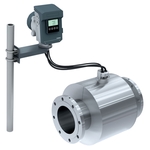
The FLOWSIC900 flowmeter has been designed from scratch for LNG measurement and utilizes many years of experience from Endress+Hauser and SICK in natural gas measurement. It is custody transfer approved according to the latest OIML R117:2019 standard for the highest accuracy class 0.3 for use in “dynamic measuring system for liquids other than water.” Considering a conservative approach, this measurement with UFM only achieves a system uncertainty of 0.3 % acc. OIML R117 standard, which would still reflect an uncertainty improvement of 0.25 % on volume (0.55 % reduced to 0.3 %) or approximately € 125 000 reduced financial uncertainty per LNG carrier (un)loading.
Are there valid concerns on using ultrasonic flowmeters?
Although the accuracy advantage supports the use of UFM, concerns regarding their suitability remain common. These concerns are briefly addressed in the following section.
A.) Transferability of calibration from laboratory to field
During the metrological type approval process according to the latest OIML R117:2019, Endress+Hauser – together with approval body, NMi – took special care to test the reliability and measurement uncertainty of the meter under cryogenic LNG conditions. [5]
This includes special transducer testing for stable and accurate readings under cryogenic conditions on a tailor-made developed cryogenic test stand, as well as the transferability from a calibration fluid (e.g. water or liquid hydrocarbons) to the target fluid LNG (with low viscosity and therewith high Reynolds number) proven on the VSL LNG test bench in Rotterdam, which is traceable to SI units. [6]
Calibration results illustrating the media transferability as well as meter linearity and extrapolation towards a higher Reynolds number are shown in the graphic beyond, which indicates that this method can be applied to LNG meters.

Measuring results acc. OIML R117:2019 requirements (error over Reynolds number) – capable for highest accuracy class 0.3.
B.) Not yet industry standard
In the past and for various reasons, the LNG or oil and gas industry has not typically utilized this new technology quickly. Traditionally, the steps to make technology an industry standard were as follows: first the technology gets available, then global, local, and company standards develop, and then the technology gets used and becomes an industry standard.
While this is the traditional and safest way to utilize new technology, it is hindering innovations slightly. On the other hand – there is no rule which states that it is mandatory for LNG transactions to follow these typical steps. Endress+Hauser invites operators and EPCs to find out which technology fits most to current and future LNG plants.
C.) Proving and recalibration
UFM technology in general can be considered drift-free and Endress+Hauser sees no technical need for regular recalibration of its LNG meter during normal operation. So, it is more a question of trust in the meter in field and how to prove that these measurement results remain trustworthy. At the time of publishing, LNG provers with capacities of up to 4500 m³/h are available, which may cover flow rates of up to 24 in. (un)loading lines or – considering extrapolation of proving – even larger [7]. Proving however is associated with practical hurdles such as transport of proving system to the meter (e.g. on a jetty), establishing metrological stability and establishing proper process connections for the prover system.
Recalibration in water or oil is generally possible but is associated with pulling the meter out of a (probably) insulated pipeline. From the manufacturer’s perspective, the most appropriate method is to re-use approaches, which are standard in natural gas and oil measurement today. This approach involves using two UFMs with different designs (possibly also from different vendors) in a master/duty configuration, where the duty meter is regularly compared to the master meter and the master meter could be sent to recalibration without stopping the complete LNG line. In other words, operators can consider initial factory calibration as still valid – as long as the master and duty meter show the same readings.
D.) Boil-off gas (BOG) effects
Ultrasonic flowmeters – like mass flowmeters – work ideally under one-phase measurement conditions. These conditions are achievable with proper operator precautions, e.g. as pre-cooling the metering line and reliable thermal insulation along the complete metering line.
FLOWSIC900’s design minimizes potential heat ingress into the measurement section and enables fast cool-down of the meter. In two-phase flow tests at the HZDR in Germany, it has been determined that measurement availability is given up to 5 % gas volume fraction (GVF).
Outlook: ultrasonic measurement technology in LNG plants
Challenges and concerns which have hindered the common use of UFM in LNG custody transfers have largely been overcome – the technology is ready. In the near future, UFMs are expected to be seen more and more in LNG plants. Firstly, they will be used as process meters on (un)loading lines for LNG pump monitoring or for LNG rundown measurement, and secondly as check meters as reference to level metering before they finally may get industry standard for LNG custody transfer. Global standards will continue to develop and ease usage of UFM or Coriolis-based LNG metering systems for LNG transactions from small to large scale. Ultimately, measurement uncertainties will further decrease, allowing LNG operators to focus on the economic and political uncertainties which will probably remain.
References
- ‘GIIGNL Annual Report 2025’, International Group of Liquefied Natural Gas Importers (GIIGNL), (2025), www.giignl.org/annual-report
- ‘Shell LNG Outlook 2025’, Shell, (2025), www.shell.com/what-we-do/oil-and-natural-gas/liquefied-natural-gas-lng/lng-outlook-2025.html
- ‘Custody Transfer Handbook’, GIIGNL, (2021), 6th edn.
- ‘Liquefied Natural Gas – LNG’, DVGW, www.dvgw.de/themen/gas/gase-und-gasbeschaffenheit/liquefied-natural-gas-lng
- WINKLER, T., BODENDORFER, K., KLUPSCH, M., RACKOW, S., KADE, A., FRIEDRICH, S., WESER, R., and EHRLICH, A., ‘113 A Cryogenic Test Setup for Characterization of Ultrasonic Flow Measurement’, 17th Cryogenics 2023 IIR Conference and Exhibition, Germany, (24 April 2023).
- GUGOLE, F., SCHAKEL, M. D., DRUZHKOV, A., and BRUGMAN, M., ‘Assessment of alternative fluid calibration to estimate traceable liquefied hydrogen flow measurement uncertainty’, International Journal of Hydrogen Energy, (21 June 2024).
- ‘Cryogenic Meter Provers for LNG Service’, Flow Management Devices, https://flowmd.com/application-specific-meter-provers/cryogenic-meter-provers-for-lng-service/